
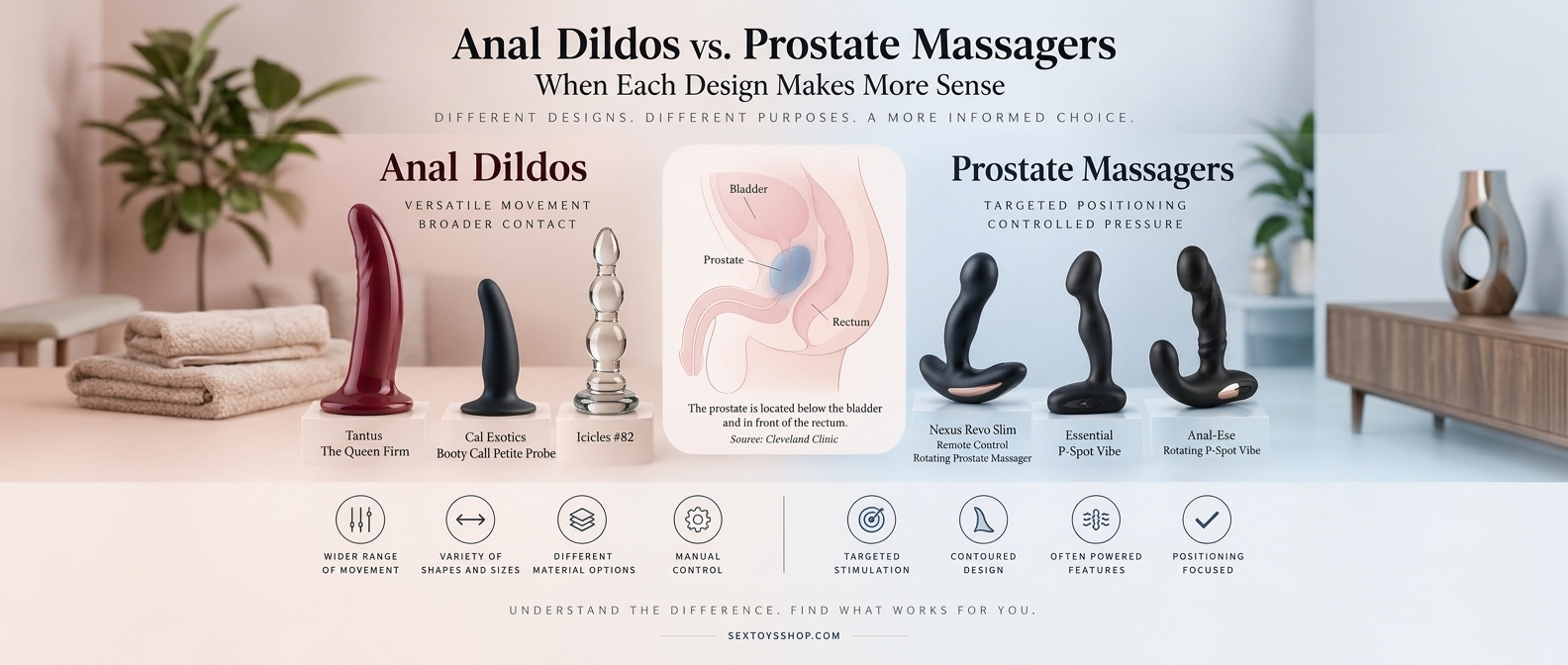
Anal dildos and prostate massagers are often grouped together, and at first glance, some designs can appear surprisingly similar. Both may use silicone, glass, or other nonporous materials. Both can be compact or relatively substantial, and both may include curved profiles or powered functions.
However, the categories are built around different design priorities.
An anal dildo generally gives the user greater freedom to control movement, angle, and depth. A prostate massager is more likely to use a specialized shape intended to maintain contact in a particular direction.
Understanding this distinction can be much more useful than comparing products by length or diameter alone.
Anal Dildo vs. Prostate Massager:
The Basic Difference
The easiest way to distinguish an anal dildo from a prostate massager comes down to intended movement versus fixed positioning.
- Prostate Massager (Design-Controlled Positioning): Engineered with specific anatomical geometry, a prostate massager aims to target the P-spot and hold a stable position once inserted, often minimizing the need for manual adjustment.
- Anal Dildo (User-Controlled Movement): Built with a shaft-based design—whether straight, curved, textured, or tapered—an anal dildo relies on the user to direct the stroke, depth, speed, and angle.
In simple terms:
Anal dildo → more user-controlled movement
Prostate massager → more design-controlled positioning
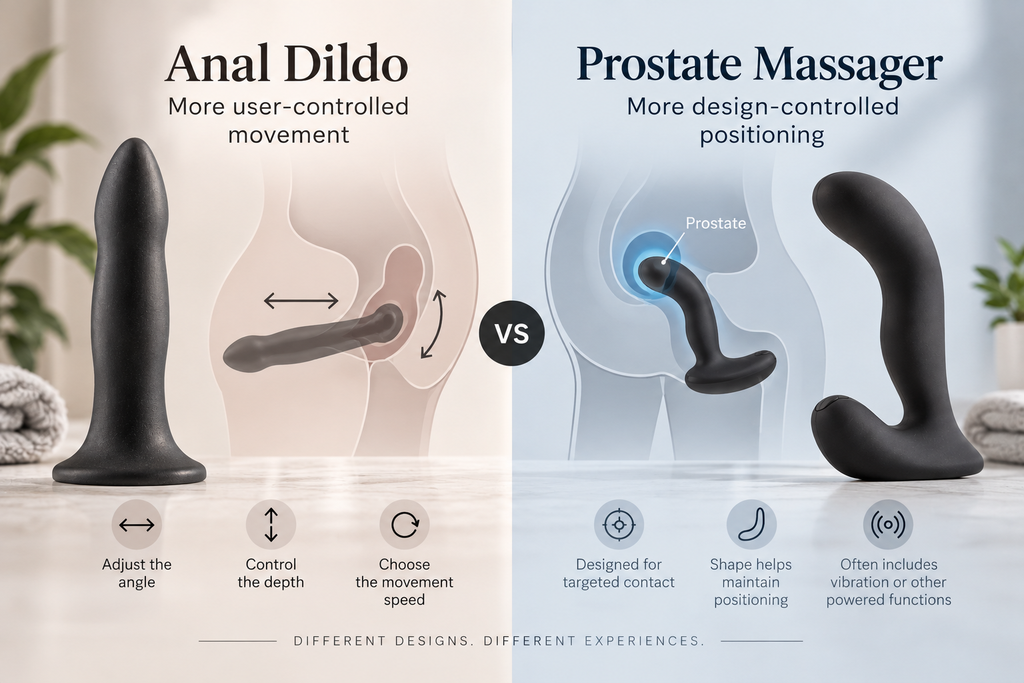
While hybrid designs exist and overlap is common across categories, this distinction offers a clear baseline for comparing the two.
The main design differences can be summarized as follows:
| Feature | Anal Dildo | Prostate Massager |
|---|---|---|
| Main priority | Versatile positioning | More targeted positioning |
| Typical profile | Shaft-based | Contoured or specialized |
| User control | Often high | Often partly determined by shape |
| Contact pattern | Adjustable and variable | More localized |
| Depth | Can be an important variable | Position may matter more than length |
| Powered movement | Available but not necessary | Common |
| Material firmness | Wide range | Can help maintain orientation |
Neither approach is inherently better. The two categories simply place emphasis on different types of control, positioning, and movement.
Why Prostate Massagers Use More
Specialized Shapes
Anatomy helps explain why prostate-oriented products frequently use curved or contoured designs.
According to Cleveland Clinic, the prostate is located below the bladder and in front of the rectum. Because of this anatomical relationship, positioning and the direction in which pressure is applied can matter more than simply increasing insertable length.
This is why many prostate massagers have relatively distinctive profiles. A curve, angled section, wider contact area, or carefully positioned motor can be used to influence the direction of contact rather than simply extend the product farther.
That makes prostate massagers an example of purposeful geometry: shape is being used to influence where and how contact occurs.
The Quest Prostate 7X Bullet Vibrator Black, available through SexToysShop, provides a useful real-world example. Its silicone construction is combined with battery-powered vibration, multiple speeds, and pulsating functions. Rather than illustrating the value of additional shaft length, it shows how prostate-oriented products can combine specialized positioning with powered stimulation.
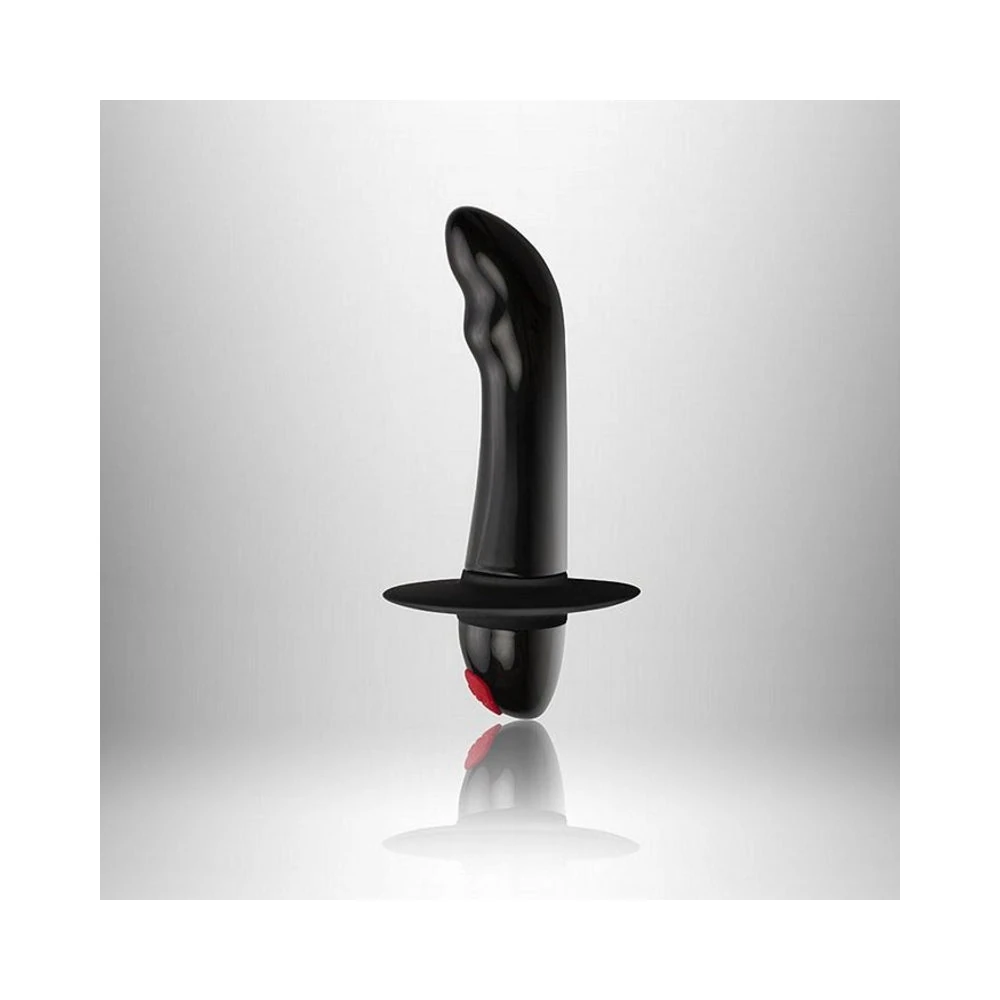
The important comparison, therefore, isn’t whether one product is larger than another. It is what the geometry and movement system are intended to accomplish.
What an Anal Dildo Prioritizes Instead
Anal dildos generally place more control in the user’s hands.
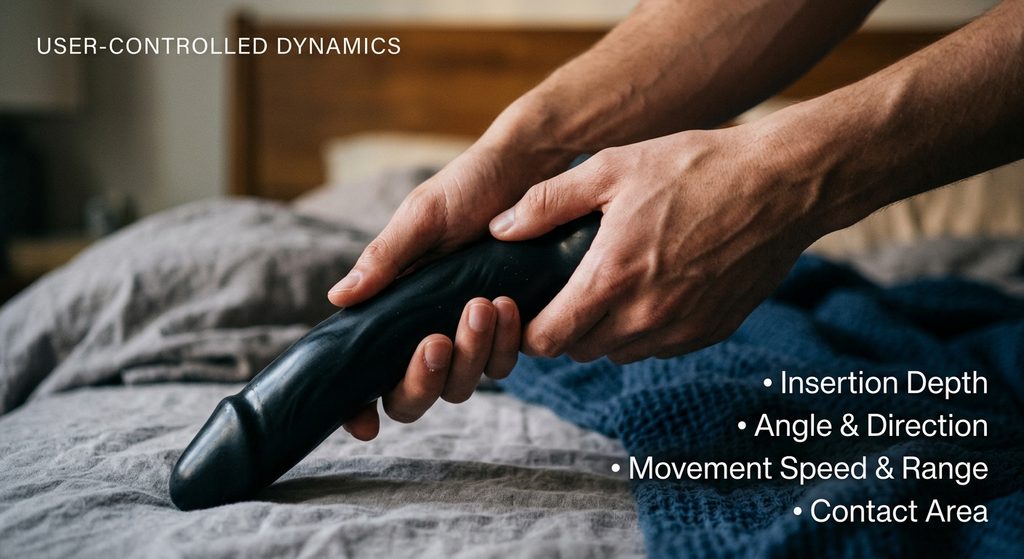
A traditional shaft profile can allow changes in:
- insertion depth;
- angle;
- direction;
- movement range;
- contact area;
- movement speed.
This versatility is one of the main reasons the category includes such a broad range of shapes and sizes.
A compact anal dildo, for example, may prioritize manageable dimensions and controlled movement. A longer design can offer a greater potential range of positioning. A tapered model changes diameter progressively, while a curved shaft changes the direction in which pressure is transferred.
The Tantus The Pawn Firm – Oxblood, listed in SexToysShop’s anal dildo collection, provides a useful example of the firmer, shaft-oriented side of this category. Unlike a powered prostate massager, this type of design leaves the movement pattern largely to the user, making angle, depth, and positioning adjustable variables rather than functions controlled by a motor.

It also illustrates why firmness matters. A structure that retains its shape consistently can transfer movement differently from a highly flexible shaft, even when two products have broadly similar dimensions.
As a result, there is no single mechanical experience associated with the term anal dildo. The category describes an intended type of use rather than one specific shape.
Vibration & Powered Functions:
Position vs. Power
Powered features highlight another key distinction between these two categories:
- Anal Dildos: Rely primarily on manual movement to achieve stimulation, though vibrating options are available.
- Prostate Massagers: Frequently feature built-in motors (offering vibration, pulsation, rotation, or rocking) so the device can deliver targeted stimulation while remaining stationary.
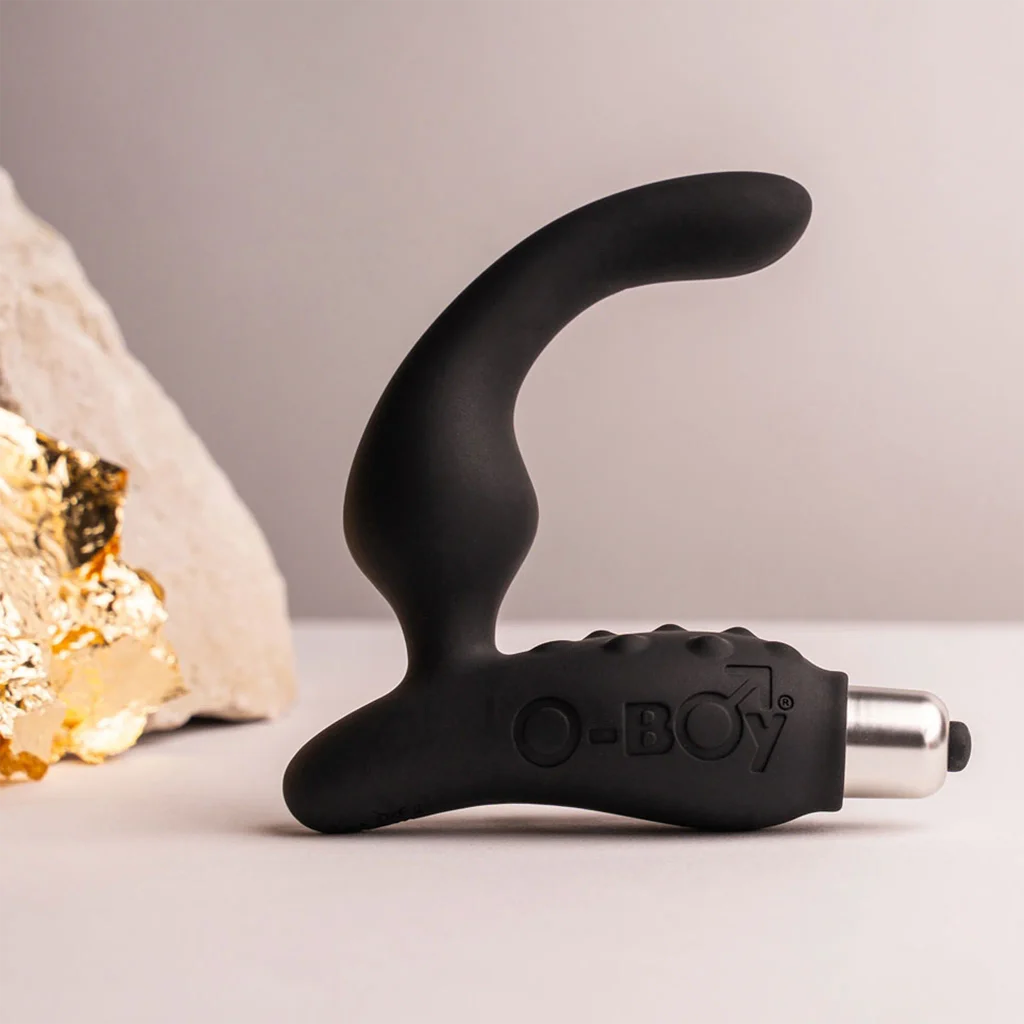
A product like the O-Boy 7 Black illustrates this design philosophy – combining a contoured silicone shape with battery-powered vibration and pulsation patterns to stimulate specific zones without needing constant manual motion.
In short:
- Manual Shaft Movement: The user changes the product’s position.
- Powered Targeted Design: The device maintains its orientation while internal motors handle the stimulation.
Note on Individual Response: Science is still mapping the exact mechanisms behind prostate-induced orgasm—a review in Clinical Anatomy highlights that current research remains limited. Because individual anatomy and sensitivity vary widely, personal experience with either style will differ.
When Does an Anal Dildo Make More Sense?
An anal dildo is often the better choice if you prioritize versatility over a fixed position. It is ideal for those who want to:
- Manually control angle, depth, speed, and motion range.
- Prefer a traditional shaft profile.
- Explore a broader spectrum of firmness levels, lengths, materials, and textures.
For example, a solid, non-vibrating option like the Tantus Acute puts complete control over position and movement directly in your hands. It isn’t inherently better than a prostate massager—it simply offers a different, more hands-on style of play.
When Might a Prostate Massager
Make More Sense?
A prostate massager is usually the better choice when targeted, stationary stimulation is your main priority.
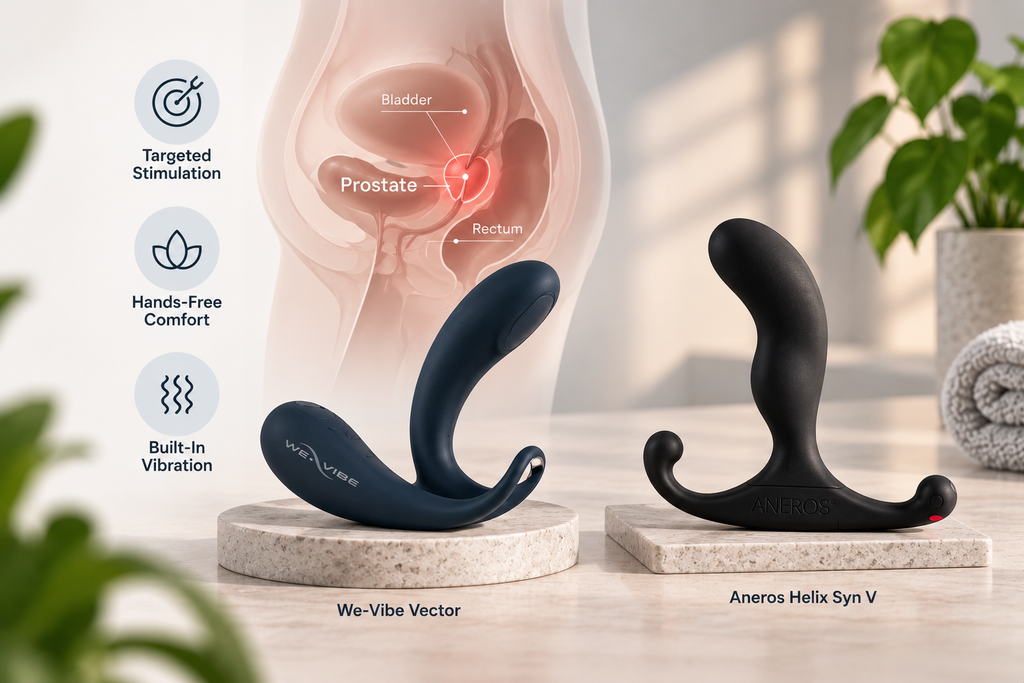
Rather than focusing on a broad range of manual movement, these devices combine specialized contours, firm positioning, and integrated technology to deliver localized focus. Premium options like the We-Vibe Vector and the Aneros Helix Syn V showcase how hands-free vibration and anatomical engineering enhance this targeted approach—the Vector using an adjustable head and app controls for customizable internal pressure, while the Helix Syn V relies on a sculpted, hands-free frame to keep dual motors locked against sensory hot spots.
A prostate massager is worth considering if you prefer:
- Anatomical design over a traditional shaft profile.
- Hands-free, localized stimulation rather than constant manual movement.
- Built-in powered features (vibration, pulsation) to drive sensation while the device stays locked in place.
Ultimately, it comes down to what you want to control: an anal dildo gives you full reign over movement and depth, while a prostate massager relies on purposeful geometry to do the work for you.
Key Takeaway
The practical difference between an anal dildo and a prostate massager is less about which category is superior and more about where the control comes from.
An anal dildo usually gives the user greater control over movement, angle, and depth. A prostate massager often transfers some of that control to the product’s geometry and, in powered designs, to its vibration or movement system.
The Tantus The Pawn Firm – Oxblood represents the more manually controlled, shaft-oriented approach, while products such as the Quest Prostate 7X Bullet and O-Boy 7 Black illustrate how prostate-focused designs can incorporate powered functions into a more specialized format.
Once that distinction is understood, specifications such as length and diameter become easier to interpret in context.
The best comparison is therefore not simply anal dildo vs. prostate massager. It is adjustable movement vs. targeted positioning—and which approach better matches the intended use.
Frequently Asked Questions
1. What is the difference between an Anal dildo and a prostate massager?
An anal dildo generally emphasizes user-controlled movement and variable positioning. A prostate massager is more likely to use specialized geometry to maintain more targeted contact.
2. Are all prostate massagers curved?
No. Designs vary, although curved, angled, or contoured profiles are common because positioning is an important part of the category.
3. Is a longer anal dildo better?
Not necessarily. Additional length increases the potential range of positioning, but shape, firmness, diameter, base design, and intended use can be equally or more important.
4. Why does firmness matter in a prostate massager?
Firmness affects how readily a product retains its intended geometry under pressure. A more flexible material may bend or compress more, while a firmer structure generally maintains its orientation more consistently.
5. Can an anal dildo and a prostate massager have similar shapes?
Yes. The categories can overlap visually. The more useful distinction is what the shape is intended to accomplish and whether the design emphasizes variable movement or more controlled positioning.
References
1. Cleveland Clinic. Prostate: Anatomy, Location, Function & Conditions. Cleveland Clinic.
2. Levin RJ. Prostate-induced orgasms: A concise review illustrated with a highly relevant case study. Clinical Anatomy. 2018;31(1):81–85. doi:10.1002/ca.23006.