
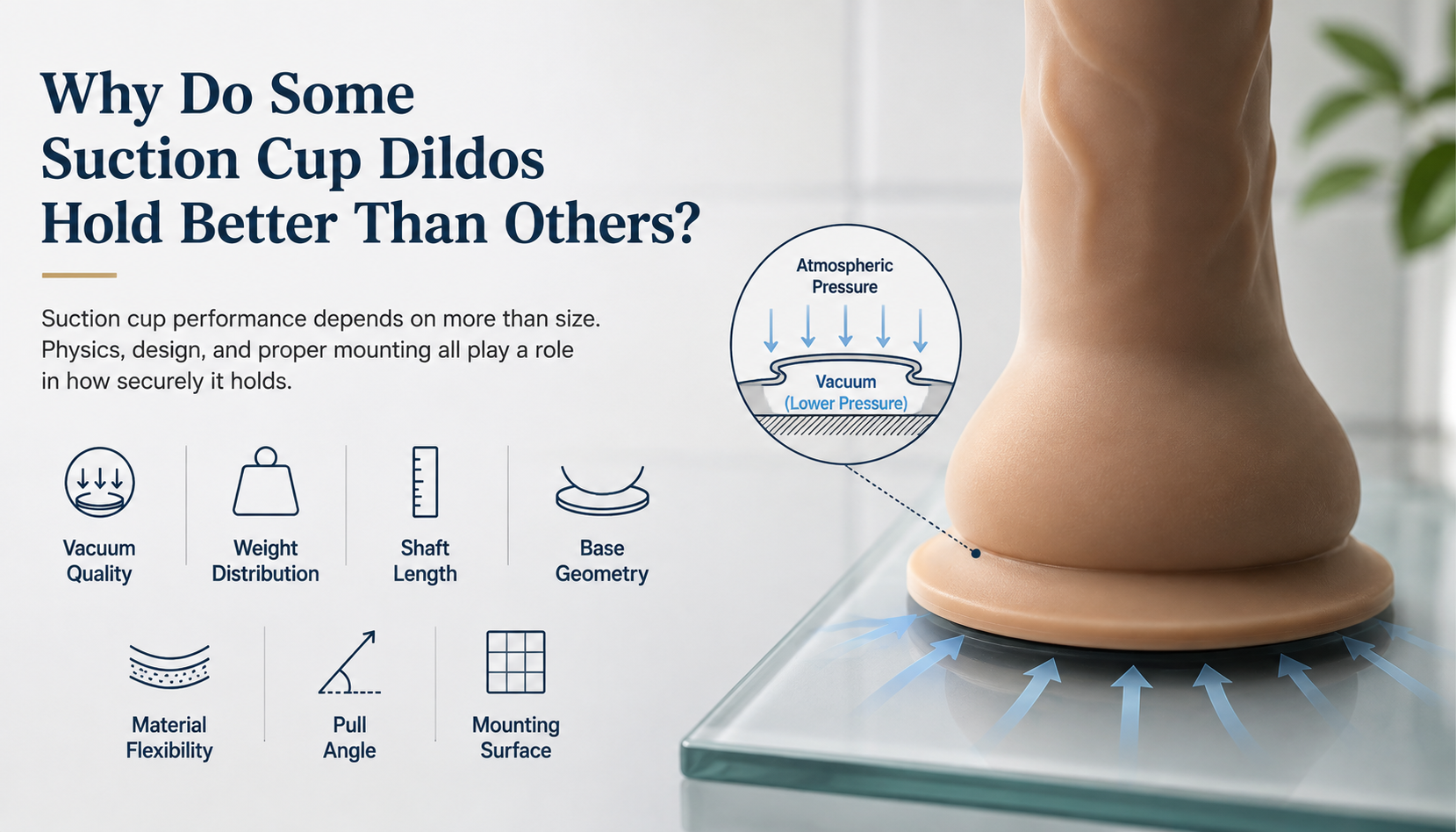
A suction cup may look like one of the simplest parts of a realistic dildo, but its performance depends on more than its diameter. Two suction cup dildos with bases of similar size can behave very differently once they are mounted to a wall, tile, glass, or another smooth surface.
The reason comes down to basic physics. Vacuum quality, weight distribution, shaft length, base geometry, material flexibility, pull angle, and mounting surface all influence how securely a suction cup holds.
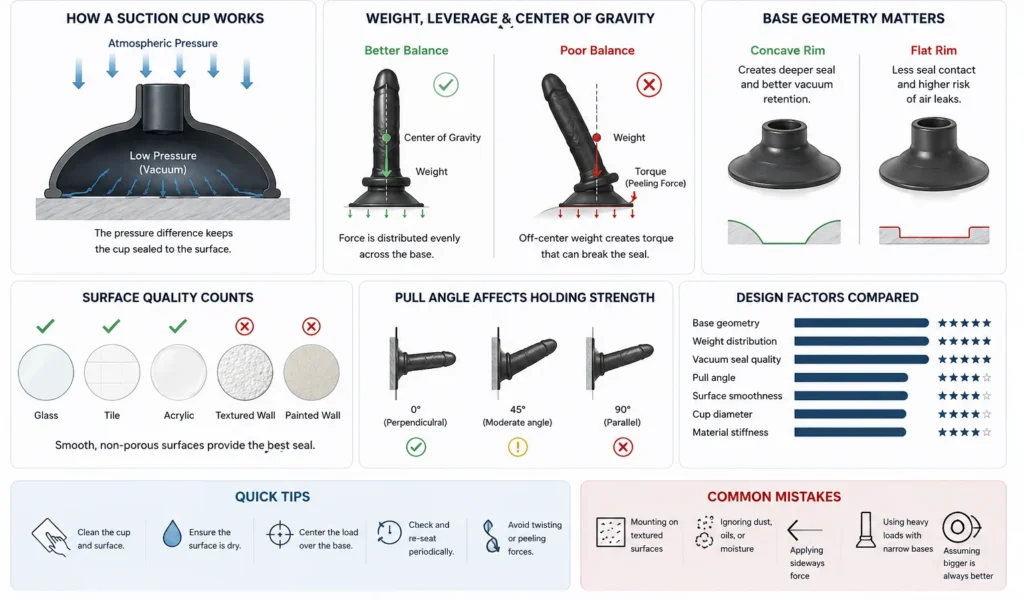
Understanding these factors can also make it easier to evaluate suction cup designs without assuming that bigger automatically means better.
How Does a Suction Cup Dildo Stay Attached?
A suction cup doesn’t hold because the material itself is sticky. When the flexible base is pressed against a smooth surface, air is pushed out from underneath it. This creates an area of lower pressure beneath the cup.
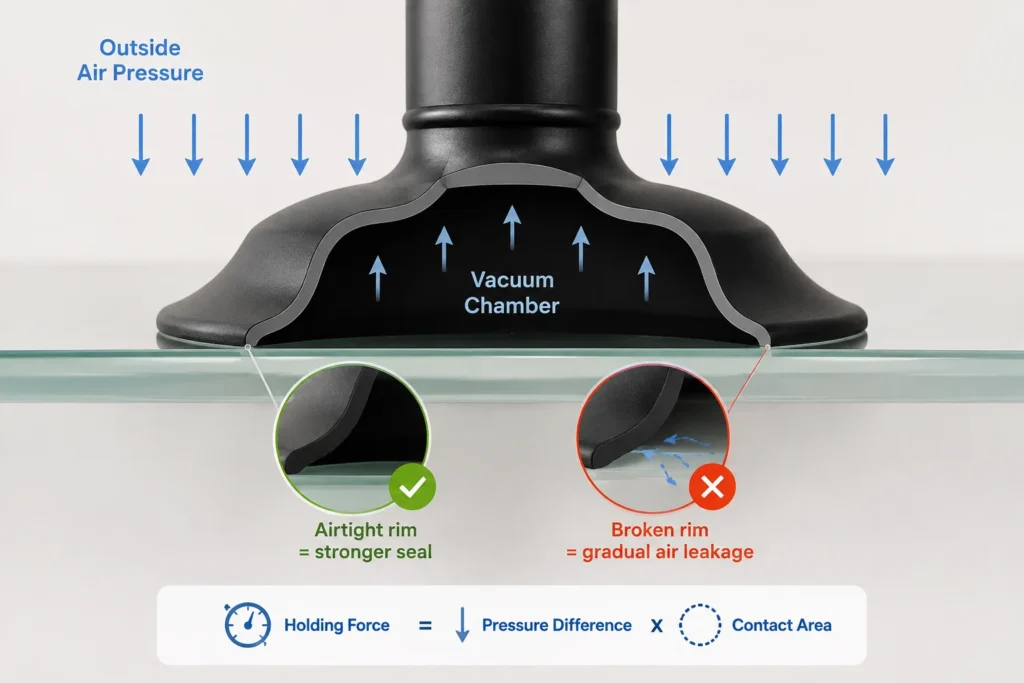
The greater atmospheric pressure outside the cup then pushes the base against the mounting surface.
In simplified form:
Holding Force ≈ Pressure Difference × Contact Area
This helps explain why a larger suction cup can provide more holding potential. More contact area gives atmospheric pressure a larger area over which to act.
But there is an important condition: the seal must remain intact.
If one edge lifts or microscopic gaps allow air underneath the base, the pressure difference begins to disappear. A large suction cup with a poor seal may therefore perform worse than a smaller cup that maintains consistent contact.
Why Weight Distribution Matters
The overall weight of a dildo affects its suction base, but where that weight is positioned can matter just as much as how much the product weighs.
When a suction cup dildo is mounted horizontally, several factors influence the load placed on the base:
- Shaft length: A longer shaft moves more of the mass farther from the mounting surface, increasing leverage.
- Shaft thickness: A thicker shaft may contain more material and therefore place additional load on the base.
- Center of gravity: The farther the center of gravity is from the suction cup, the greater the rotational force acting on the seal.
- Base size and geometry: The suction base must distribute these forces while maintaining continuous contact with the surface.
The basic relationship is: Torque = Force × Distance
As the distance between the load and the mounting surface increases, torque increases. This can begin to lift one edge of the suction cup rather than pulling the entire base away at once. Once air gets beneath the rim, vacuum retention decreases.
Thickness and Mass Distribution
The Realrock Extra Thick 8 In. Dildo Beige provides a useful example of how shaft thickness can affect mass distribution:
- A thicker shaft generally contains more material.
- Additional material can contribute to greater overall mass and increase the load supported by the suction base.
- The position of that mass affects how much rotational stress reaches the rim.
- A thicker shaft doesn’t automatically require the largest possible suction cup; shaft dimensions, weight distribution, and base design need to work together.
Length and Leverage
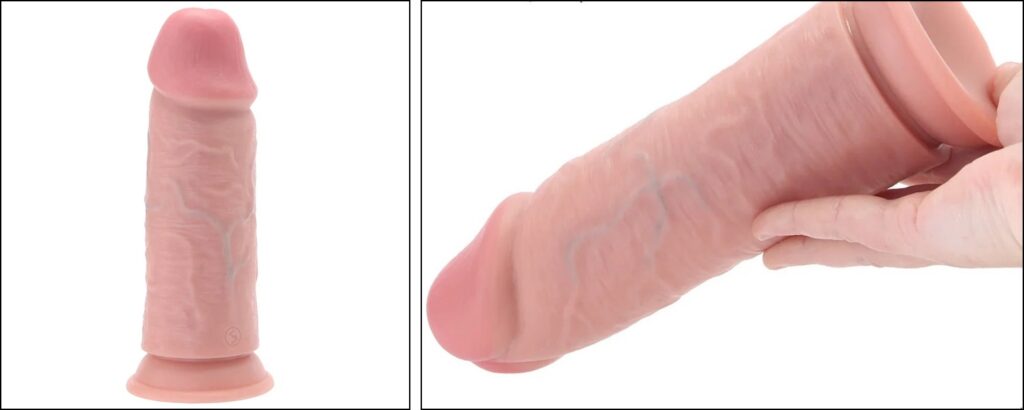
The Au Naturel Daddy 14″ Sensa Feel Dual Density Dildo illustrates a different factor: length.
- A longer shaft can position its center of gravity farther from the wall.
- Greater distance creates a longer moment arm.
- A longer moment arm increases torque around the suction base.
- Increased torque can place more peeling stress on one side of the seal.
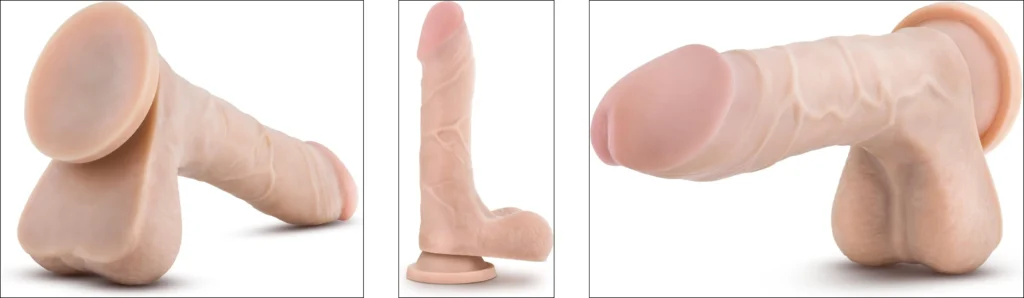
This is why suction cup diameter alone can be misleading. Two bases of similar size may experience very different forces depending on the length, thickness, weight, and balance of the shaft.
Shaft Angle Can Change the Load
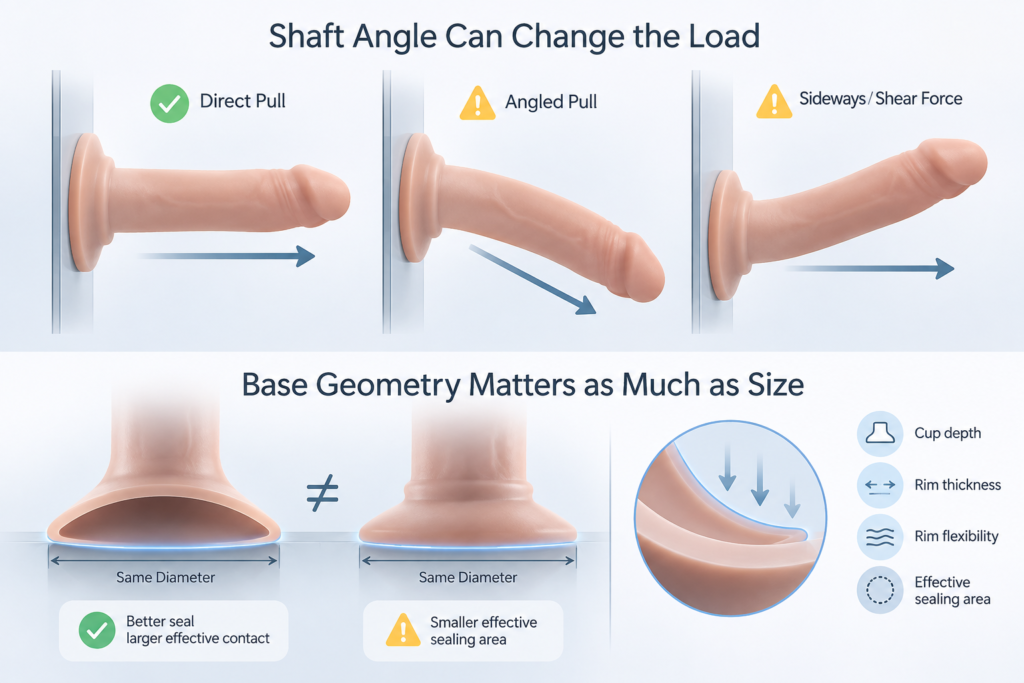
Weight determines how much force acts on the suction system, while shaft angle determines how that force is directed toward the base. A centered load generally distributes stress more evenly, while an angled or off-center load can place greater stress on one side of the suction cup.
The main loading conditions are:
- Direct pull: Force acts outward from the mounting surface, keeping the load relatively evenly distributed across the base.
- Sideways or shear force: Force moves parallel to the surface, which can cause the suction cup to shift or deform.
- Angled pull: Force acts away from the centerline, increasing leverage and concentrating peeling stress along one edge.
- Edge lifting: If the rim begins to separate from the surface, air can enter beneath the cup and gradually weaken the vacuum.
In general, the more off-center the load becomes, the more difficult it is for the suction cup to maintain an even seal.
Base Geometry Matters as Much as Size
Suction cup diameter is easy to compare, but size alone doesn’t describe how effectively a base can maintain a seal. Shape, rim design, flexibility, and actual contact with the mounting surface all matter.
Important design factors include:
- Cup depth and curvature: These influence how the base deforms when pressed against a surface and how the low-pressure area is formed.
- Rim thickness: The sealing edge needs to maintain continuous contact around the cup.
- Rim flexibility: A flexible rim may conform more easily to minor surface variations.
- Base stiffness: A very rigid base may have more difficulty adapting to an imperfect surface.
- Effective sealing area: The outer diameter doesn’t necessarily represent the entire area actually maintaining the vacuum.
For this reason, two suction cups with the same outer diameter can have very different sealing and holding characteristics.
The Signature Cocks Ricky Johnson 10-inch Ultraskyn Cock With Removable Vac-U-Lock Suction Cup provides another useful example. Because its suction cup is part of a removable Vac-U-Lock mounting system, the connection between the shaft and base becomes another element of the overall design.
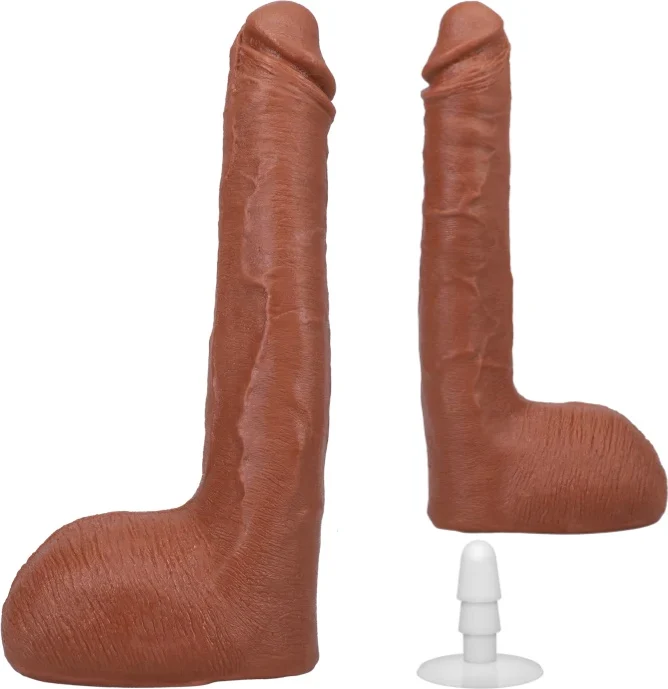
In this type of system, factors such as base geometry, connection stability, and how centrally the load is transferred to the suction cup can all influence how forces reach the seal. It illustrates why suction performance should be evaluated as a complete mounting system rather than by cup diameter alone.
Does Dildo Flexibility Affect Suction?
Yes. Shaft flexibility affects how movement and force are transferred to the suction base. Neither a very flexible nor a very rigid design is automatically better.
Key factors include:
- Dual-density construction: Combines different levels of firmness, potentially changing how forces travel through the shaft toward the base.
- Rigid shafts: Transfer movement more directly to the suction base, which can place sudden loads on the seal.
- Flexible shafts: Can bend under load, absorbing or redirecting some movement before it reaches the base.
- Excessive flexibility: May create additional movement and make the load less stable.
- Excessive rigidity: May transfer more abrupt forces directly to the suction cup and its rim.
The King Cock Elite Silicone Dual-Density Cock 7″ illustrates this type of construction. Its combination of a firmer internal structure and softer exterior provides a useful example of how different material densities can affect the way movement travels through the shaft toward the suction base.
From an engineering perspective, this means material construction should be considered part of the overall suction system rather than a completely separate feature.
Why Can Suction Cups Fail on Smooth Surfaces?
Glass, polished tile, acrylic, and similar non-porous materials generally provide favorable conditions for suction cups.
However, a surface that looks smooth isn’t necessarily perfectly smooth at a microscopic level.
Research into rubber seals and contact mechanics has shown that surface roughness can create microscopic non-contact regions and leakage pathways between sealing surfaces. Air can gradually move through these pathways, reducing the pressure difference that helps maintain the seal. Huon et al. (2022), Tribology Letters
Similar research into static sealing interfaces shows how microscopic gaps and surface roughness influence leakage behavior, reinforcing why visually smooth surfaces do not necessarily form perfect seals. Fischer et al. (2020), Tribology Letters
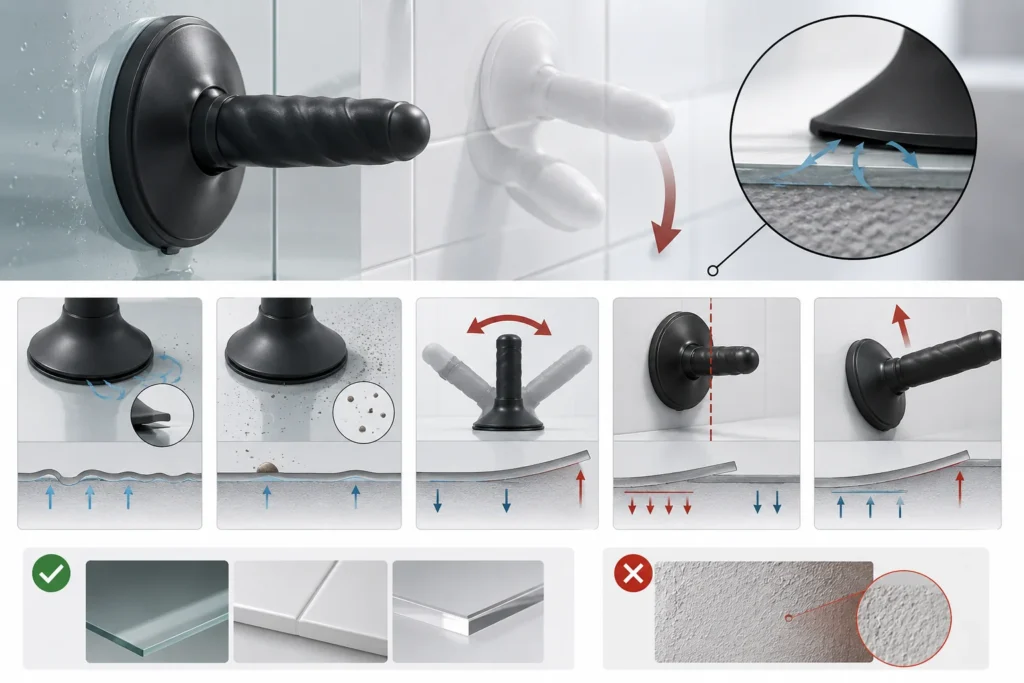
Everyday factors can make this effect worse:
- dust or skin oils on the surface
- residue on the suction cup
- grout lines
- textured or porous finishes
- an uneven or folded section of the rim
- excessive sideways loading
Even a suction cup that initially feels secure may therefore gradually lose its vacuum.
This also explains why a painted wall can perform differently from glass or polished tile. Paint may look smooth to the eye while still having enough microscopic texture to interfere with continuous contact around the sealing rim.
What Makes a Strong Suction Cup Dildo?
There isn’t one measurement that reliably predicts suction performance. Instead, the design should be considered as a complete mechanical system.
- Suction cup geometry: Is the base shaped to create and maintain a consistent seal?
- Effective contact area: How much of the base actually seals against the mounting surface?
- Weight distribution: Is substantial mass positioned far away from the base?
- Shaft length: Longer designs can create greater leverage when wall-mounted.
- Shaft thickness: Additional material can change both weight and center of gravity.
- Material stiffness: Flexible and rigid structures transmit loads differently.
- Shaft angle: Off-center geometry can increase peeling stress.
- Mounting surface: Smooth, clean, non-porous surfaces generally provide better sealing conditions.
Looking at these factors together gives a more useful picture than comparing cup diameter alone.
How to Improve Suction Cup Holding Power
Even a well-designed suction cup depends on proper mounting conditions. A few simple steps can help create a more reliable seal:
- Clean both the suction cup and mounting surface before attachment.
- Choose smooth, non-porous surfaces such as glass or polished tile.
- Avoid grout lines, textured paint, and porous materials.
- Press the center of the suction cup firmly to push trapped air outward.
- Make sure the entire rim lies flat against the surface.
- Avoid unnecessary twisting after the vacuum has formed.
- Minimize extreme sideways or angled loading when possible.
If a suction cup repeatedly loses its grip, the problem isn’t necessarily its diameter. Surface texture, contamination, base deformation, weight distribution, or pull direction may be responsible.
However, a surface that looks smooth isn’t necessarily perfectly smooth at a microscopic level. Recent research on electroadhesion suction cups published in *Advanced Materials* highlights the importance of surface conditions and contact quality in maintaining effective adhesion.
Does a Bigger Suction Cup Hold Better?
Potentially – but not automatically.
Increasing contact area can increase theoretical holding force, which gives larger suction cups an advantage under ideal conditions.
Real-world performance, however, depends on maintaining the pressure difference beneath the cup.
A smaller, well-sealed base operating under a balanced load may outperform a larger cup whose rim repeatedly lifts because of torque or poor surface contact.
That’s why suction cup diameter should be treated as one design variable rather than a complete measure of suction strength.
Frequently Asked Questions
1. Does a bigger suction cup always hold better?
No. A larger contact area can help, but base geometry, seal quality, weight distribution, and pull angle also affect holding performance.
2. What surface is best for a suction cup dildo? Smooth, clean, non-porous surfaces such as glass, polished tile, and acrylic generally provide the best conditions for maintaining a vacuum seal.
3. Why does a suction cup lose its grip over time?
Small amounts of air can gradually enter beneath the rim because of surface texture, residue, edge lifting, or sideways loading, reducing the vacuum and weakening the hold.
Final Thoughts
Suction cup performance depends on much more than base size. Vacuum quality, base geometry, weight distribution, shaft dimensions, material stiffness, pull direction, and mounting surface all work together to determine stability.
When choosing a suction cup dildo, consider the overall design rather than simply looking for the largest base. Comparing different dildos with suction cups can help illustrate how shaft dimensions, materials, and base designs vary between models.
References
1. Huon, C., Tiwari, A., Persson, B. N. J., et al. (2022). Air, Helium and Water Leakage in Rubber O-ring Seals with Application to Syringes. Tribology Letters.
2. Fischer, F. J., Schmitz, K., Tiwari, A., Persson, B. N. J., et al. (2020). Fluid Leakage in Metallic Seals. Tribology Letters.
3. Advanced Materials. (2025). Electroadhesion Suction Cups. Wiley.
Read Next:
Why Some Realistic Dildos Stimulate the G-Spot Better Than Others — explore how shape, angle, firmness, and design can influence G-spot stimulation.